
Vale Douzaine raises concerns over proposed northern housing developments
Mon 16 Nov 2026
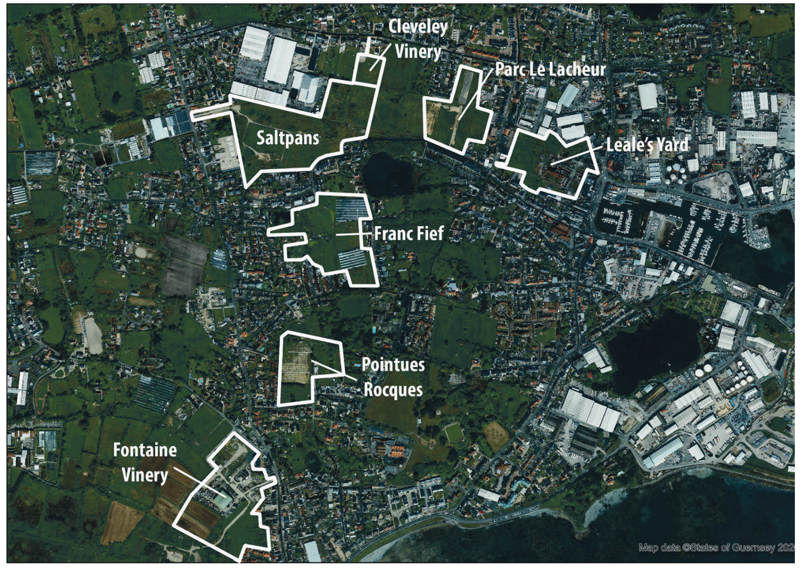
Areas earmarked for development in the north of the island: Cleveley Vinery, Parc Le Lacheur, Leale's Yard, Saltpans, Franc Fief, Pointues Rocques and Fontaine Vinery. (Digimap image)
It is warning that the combined impact on roads, drainage, local services and employment land needs to be properly assessed before changes to the Island Development Plan are approved.
In a submission going to all States Members, Vale Constable Richard Leale, on behalf of the Constables and Douzaine, has highlighted the proposals for up to 1,000 additional homes in a relatively small area, much of it low-lying or potentially vulnerable to flooding.
He said the Douzaine fully recognises the urgent need for more affordable housing in the island. However, members believe that the requirement could be met more effectively by identifying a wider range of sites across the island, particularly locations where development could proceed more quickly, with less pressure on existing infrastructure, more open space and less additional traffic congestion.
Cumulative impact on the Vale
Among the main areas of concern are Route Carré, Sandy Hook, Saltpans and Parc Le Lacheur, together with other existing and proposed developments in the L’Islet area.
While much of development area was outside of the Vale, the Douzaine was worried that the individual proposals were being assessed largely on their own, individual, merits, without a sufficiently clear picture of their combined, overall effect on the Vale itself.
This is particularly important given the reliance being placed on Saltpans and Parc Le Lacheur, which together are expected to provide almost 400 affordable homes. More than half of those are expected to come from these two locations.
Mr Leale said that creates a significant risk if development is delayed, proves more expensive than anticipated or cannot deliver the numbers assumed. It also raises the question of whether an island-wide housing requirement is being met disproportionately by one relatively small part of Guernsey.
“I can just imagine what the Vale’s greatest champion (the late Deputy Dave Jones) would have to say about that,” said Mr Leale. “All this development being crammed into the north of the island while the national park (upper parishes) remain untouched.”
“If this goes ahead, I think it is realistic to predict that property prices in the Vale and St Sampson’s will fall while those in the so-called national park will inevitably increase. That doesn’t seem particularly equitable to me.”
Roads, drainage and local services
As a result, the Douzaine is calling for a proper assessment of the combined effect of these developments on traffic through L’Islet and the Bridge, pedestrian and cycling safety, school and commuter traffic, public transport and emergency-service access.
Mr Leale noted that the States’ planning consultants, Ridge and Partners, were supposed to pull all the elements of the building and wider impacts together but questioned why that wasn’t being done at outset, which would make far more sense to the Douzaine.
For this reason it believes that a network-wide transport assessment should be completed before the revised development plan is taken forward, rather than leaving the cumulative effects to be considered through separate planning applications.
Mr Leale's letter also says there are important questions about drainage, sewerage and surface water capacity. Given the low-lying nature of some of the proposed sites and the history of horticultural use, infilled land and former quarries in the area, the Douzaine believes that ground conditions, contamination, flood risks and the capacity of existing infrastructure must be properly investigated at an early stage.
Protecting employment land and the character of the parish
The proposed redevelopment of Saltpans would also result in the loss of existing industrial land, with Belgrave Vinery being proposed as an alternative industrial area.
The Douzaine wants reassurances that this is a genuinely suitable replacement for existing businesses, taking account of access, servicing, delivery routes, relocation costs and the needs of local operators.
“Simply replacing industrial land on a map does not necessarily mean providing an equivalent and practical alternative,” said Mr Leale.
The Douzaine also believes that new housing must respect the character of surrounding areas. Higher density development might be appropriate in some locations, but building heights, parking, landscaping, open space and the amenity of neighbouring properties must all be properly considered. Affordable housing should be built to the same standards of design and quality as other residential development.
Finally, the Douzaine was concerned that simplifying some of the planning requirements to speed up housing delivery could reduce opportunities for residents and the parish to influence the overall design, access, infrastructure and facilities associated with major developments.
A need for proper safeguards
The Douzaine is seeking greater transparency about how deliverable the proposed housing sites really are. Some have progressed much further than others, while sites such as Sandy Hook still require significant investigations into ground conditions and potential remediation costs.
There had to be clear deadlines and meaningful milestone requirements for developers, so that sites allocated for affordable housing did not remain undeveloped indefinitely.
Mr Leale said the Douzaine was not seeking to prevent much-needed housing development, but wanted to ensure that the consequences for the Vale and neighbouring parishes were properly understood before binding decisions were made.
The Douzaine is calling for a comprehensive assessment of the cumulative impact of the proposed developments, covering housing numbers, traffic, pedestrian safety, drainage, utilities, schools, community facilities and the loss and replacement of employment land.
Mr Leale said: "Our position on this is quite straightforward: Guernsey needs more homes, particularly affordable homes, but the burden of providing them should be fairly distributed across the island, and development in the north must be supported by the infrastructure, safeguards and investment needed to make it sustainable for existing as well as future residents.”